Extract the truth
⯆
Publish What You Pay or PWYP is a global network of civil society organizations united in their call for transparency and accountability in the extractive sector so that oil, gas and mining revenues improve the lives of people in resource-rich countries. resources. Created in 2002 to campaign for Extractive Industries to publish their payments to governments and for governments to disclose their revenues, it has grown into a global coalition of more than 700 member organizations in 45 countries. The Extractive Industries Transparency Initiative (EITI) was born out of this campaign. More than 50 countries now produce EITI reports and Madagascar is one of them. These reports are becoming increasingly detailed and focus on government revenue flows from mining, gas and oil extraction. According to its strategic plan, « PWYP works to promote transparency, accountability and citizen participation at all levels of the extractive industry: from local communities in mining areas to national governments, regional mining governance frameworks
The PWYP Madagascar national coalition, working in the field of good governance of the Extractive sector, was created in March 2012 after the vote in the General Assembly of some 69 Civil Society Organizations spread throughout the island with the financial support of Catholic Relief Services (CRS) through the Taratra Project, an advocacy project for good governance of extractive industries within the Conference of Bishops of Madagascar. It is normally part of the East and South Africa region but being a mainly French-speaking country and following a decision of the International Secretariat of PWYP, it is now integrated into the Central and French-speaking Africa region. The national coalition aligns with PWYP’s vision which is to « build a national movement of civil society organizations that make the governance of extractive industry sectors (mining, oil and gas) open, accountable, sustainable, fair and suitable for all people. »
The members of PWYP Madagascar are made up of civil society organizations and citizens involved in the extractive sector, good governance but also other cross-cutting areas such as the environment, human rights, land and development. other areas. These organizations are gathered around one observation: three quarters of the Malagasy population live below the poverty line, even though the country is a veritable geological paradise arousing the interest of investors. The Coalition has thus set itself the mission of ensuring that the revenues from the extractive industries serve as a basis for development and the improvement of the living conditions of the population. Since 2012, it has been chaired successively by KMF-CNOE, then by TI-MG and finally by the TARATRA Project.
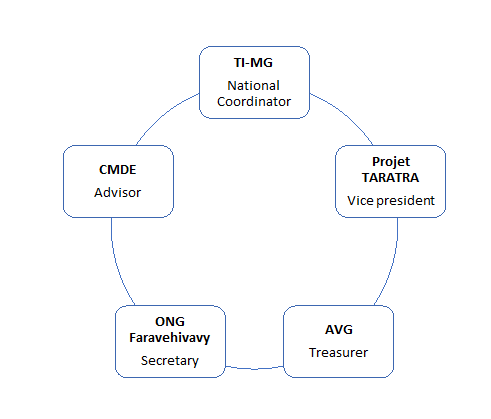
Since 2020, TI-MG was elected to coordinate the national Coalition for the next two years. The officers are presented in the figure below :
The coalition participated in all PWYP activities in general including:
Despite a weak mobilization of the members of PWYP Madagascar because of many challenges (financial, coordination, commitment and motivation), collaborations with international organizations or members of PWYP in other countries do however exist, in particular with organizations such as ALT UK, PWYP UK and the regional PWYP coalition. This collaboration with ALT UK and PWYP UK has made it possible to have a campaign on several themes in the field of environmental monitoring, in particular the possibility of the existence of radioactivity in the water near the Rio Tinto / QMM operation in Madagascar.
A memorandum of understanding was signed with the Court of Auditors in February 2020 as part of the collaboration for investigations in the field of Extractive Industry in Madagascar. This collaboration is part of the implementation of the Extractive Industries Monitoring Support Program (PASIE). In 2017, a framework for collaboration was defined with the PWYP East and Southern Africa Regional Coordination through the Southern Africa Resources Watch (SARW) within the framework of funding for the Open Society Initiative for Southern Africa (OSISA). It provides access to institutional support from the coalition, with two objectives:
To properly define its strategy for the next three years, PWYP Madagascar must have a good understanding of the current context of the extractive industries, and take into account the constraints and requirements linked to certain legal mechanisms, mechanisms and instruments.
The EITI notes that due to the incessant fluctuation of the price of raw materials in IE at the level of the world market, many countries find themselves in debt difficulties due to poor planning or management of the financial flows generated. Indeed, each mining or oil project must have its own fiscal modeling at the level of the administration. Failing to develop skills at the level of civil servants and also members of civil society who have benefited from foreign scholarships on tax modelling, the State finds itself cut off from the profits generated by taxation. While these extractions have many mostly negative social and environmental side effects, these non-renewable resources should generate revenue that should be used in sustainable projects for future generations.